Dental records release form
A free, editable Word form for a dental practice, with the core elements and required statements in 45 CFR 164.508(c) and a line for radiographs, photos and scans. Before you use it, check whether you need a form at all — moving records to another dentist usually doesn't.
This form
Free
Word .docx · 2 pages · 76 KB · no sign-up
Download the free templateFull dental practice kit
$299 one time
$249 launch price for the first 30 days after sales open · 12 months of updates
- This form, plus the records request and marketing authorization forms
- Policies, risk analysis, Notice of Privacy Practices, BAA
- A filled-in example dental practice to copy from
Version 1.0 · Checked against 45 CFR on · Made by hipaa.systems — how we check · Not legal advice
At a glance
A dental records release form documents a patient's authorization for a use or disclosure that HIPAA does not otherwise permit or require. Sending records or X-rays to another dentist or a dental laboratory for the patient's treatment does not need one (45 CFR 164.506(c)(2)), subject to agreed restrictions and applicable state law. A patient asking for their own copy — or, through a signed written request identifying the recipient and where to send it, for an electronic copy of PHI held in your EHR to go to someone else — makes a records request instead. This free Word form has the core elements and statements of 45 CFR 164.508(c) and a line for radiographs, photos and scans.
| To another dentist or lab for treatment | No release form needed under HIPAA (45 CFR 164.506(c)(2)) |
|---|---|
| Patient's own copy; or a signed written direction to send an electronic copy of PHI held in an EHR to a named recipient | A records request, not an authorization (45 CFR 164.524) |
| Other disclosures | First check whether HIPAA permits or requires them without an authorization; if not, this form (45 CFR 164.508) |
| Format | Word (.docx), 2 pages; opens in Google Docs |
| Keep signed forms | Six years from signing or last in effect, whichever is later (45 CFR 164.530(j)) |
Which form you need
- Another dentist, a specialist or a dental laboratory needs records or X-rays for the patient's treatment: HIPAA does not require a release form (45 CFR 164.506(c)(2)). Check any restriction you agreed with the patient, and any state rule.
- The patient asks for their own copy of their records or X-rays: that is a records request under the right of access (45 CFR 164.524), answered within 30 days.
- The patient asks in a signed, written request for an electronic copy of their records in your electronic health record to be sent to someone they name: that is also a records request, not an authorization.
- Other disclosures: first check whether HIPAA permits or requires the disclosure without authorization. If no other basis applies, use this form — for example, for a life-insurance application or an employer or school form you send.
HIPAA for dental offices — the full picture
Don't use it for
- Treatment, payment or health care operations — claims and predeterminations included — HIPAA allows these without an authorization
- Before-and-after photos or testimonials used to promote the practice — that needs a marketing authorization
- Psychotherapy notes, or records of a federally assisted substance use disorder program (42 CFR Part 2)
- A sale of PHI — this form does not include the additional remuneration statement required by 45 CFR 164.508(a)(4)
- The few cases where a service may depend on signing (45 CFR 164.508(b)(4)) — the form must then state the consequences of refusing
Want the general rules on release forms? Read HIPAA release form: when you need one and required fields.
Preview
Tap a page to open the full PDF in a new tab.
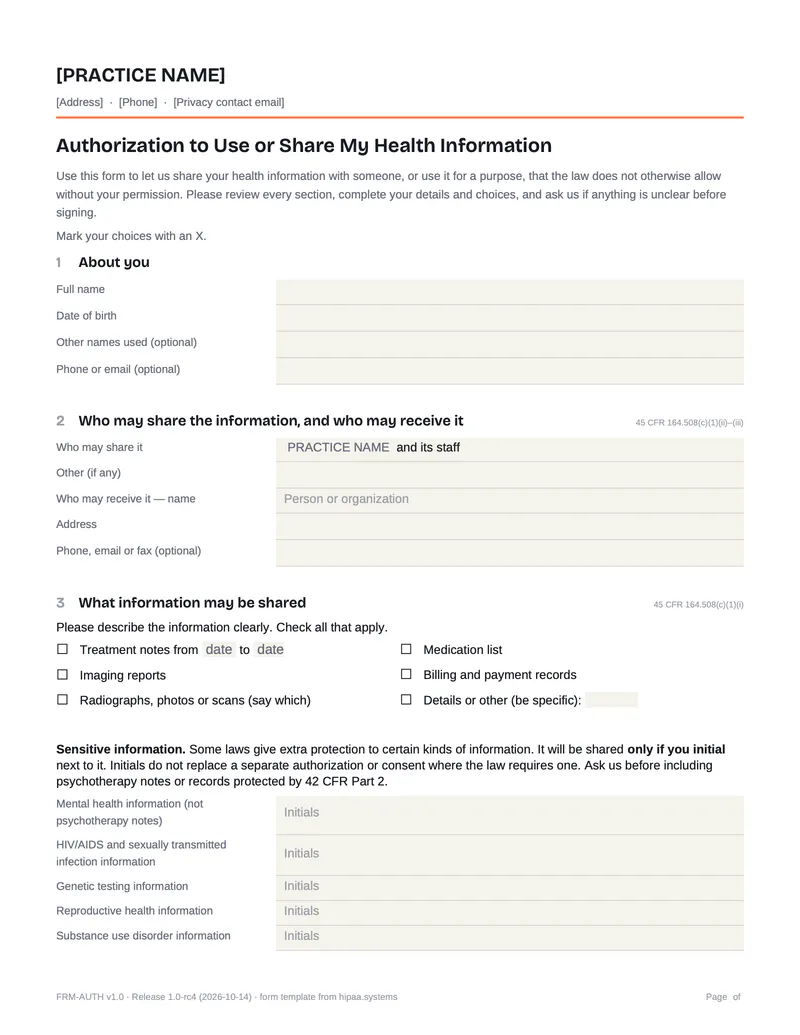
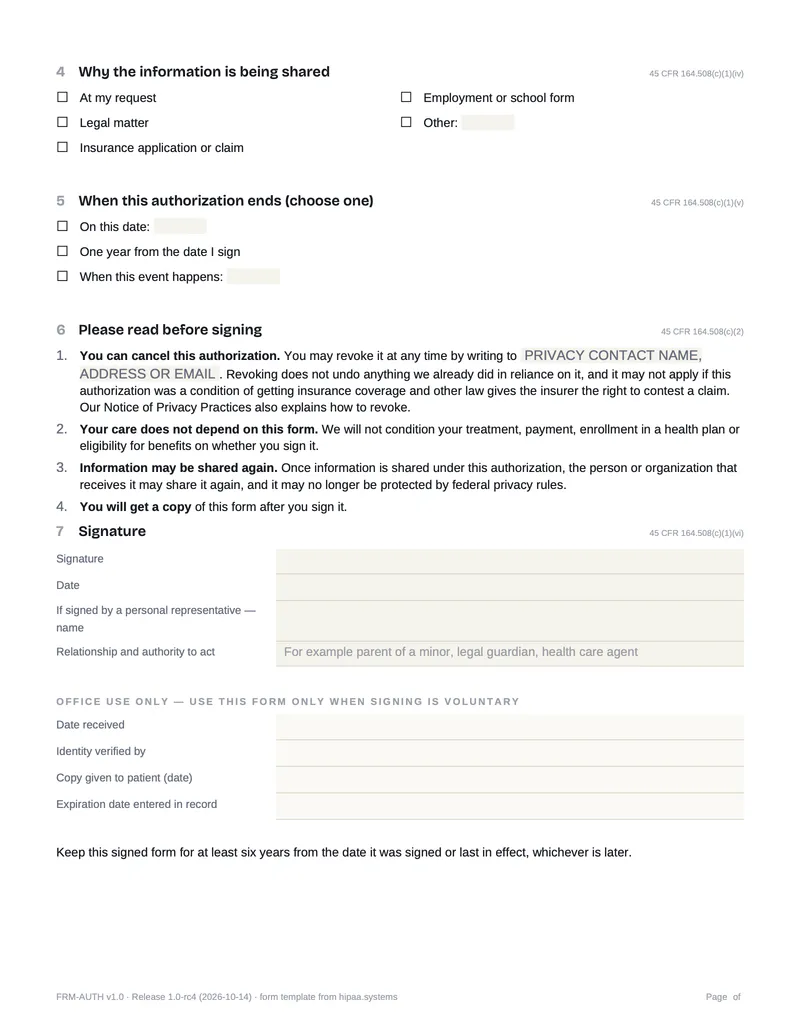
Download the free template Word .docx · 2 pages · 76 KB
How to use it
- Replace [PRACTICE NAME], the address, phone and privacy contact in the letterhead and in section 6.
- Check your state's rules: some states require specific wording or a separate consent for certain information, and your state dental board may have its own rules on records.
- Use it only when an authorization is needed — not for another dentist treating the patient, and not for the patient's own records request.
- Give the patient a copy and keep the signed form six years from signing or last in effect, whichever is later. A written revocation stops future sharing from the day you receive it; it doesn't undo what you already did.
See the legal requirements this form covers
| Requirement | Where | Source |
|---|---|---|
| Core elements: the information, who shares it, who receives it, the purpose, when it ends, the signature | Sections 2–5 and 7 | 45 CFR 164.508(c)(1) |
| A specific description of the information, with radiographs, photos or scans named and dated | Section 3 | 45 CFR 164.508(c)(1)(i) |
| Statements: right to revoke, care doesn't depend on signing, information may be re-disclosed | Section 6 | 45 CFR 164.508(c)(2) |
| Plain language | The whole form | 45 CFR 164.508(c)(3) |
| Copy for the patient | Office use | 45 CFR 164.508(c)(4) |
| Identity or authority check, when not already known | Office use | 45 CFR 164.514(h) |
Frequently asked questions
Do I need a release form to send X-rays to a patient's new dentist?
Not under HIPAA. Sharing records or X-rays with another provider for the patient's treatment is permitted without an authorization (45 CFR 164.506(c)(2)), subject to any restriction you agreed to. Many offices still ask for a signed request as their own practice, and state law can add rules.
Can a patient get copies of their own X-rays?
Yes. Radiographs and scans kept in the patient's record are part of the right of access. Provide them in the form and format the patient asks for if you can readily produce it, or in another readable format you agree on, within 30 days (45 CFR 164.524). You do not have to take a new image. You must export or convert existing information into the requested format if it is readily producible; you do not have to buy new software to support an otherwise unavailable format.
Can the office charge for copies?
For a patient's own copy, HIPAA allows only a reasonable, cost-based fee (45 CFR 164.524(c)(4)). After the Ciox Health v. Azar decision (2020), those fee limits do not apply to copies sent to a third party at the patient's direction; state law may still set fees.
Is there an official dental records release form?
No. HHS does not publish a mandatory form. Any form works if it contains the elements and statements in 45 CFR 164.508(c) and is written in plain language.
Can patients sign it electronically?
Yes, if the electronic signature is valid under applicable federal and state law. HIPAA requires a signature and a copy for the patient; it does not prohibit electronic signatures.